

Opinion analysis by Supportive Oregonians · Updated Aug. 23, 2026 · Records checked Aug. 22, 2026
Bonamici vs. Dr. Kahl: Socialism, the DSA and the Choice Facing Oregon’s 1st District
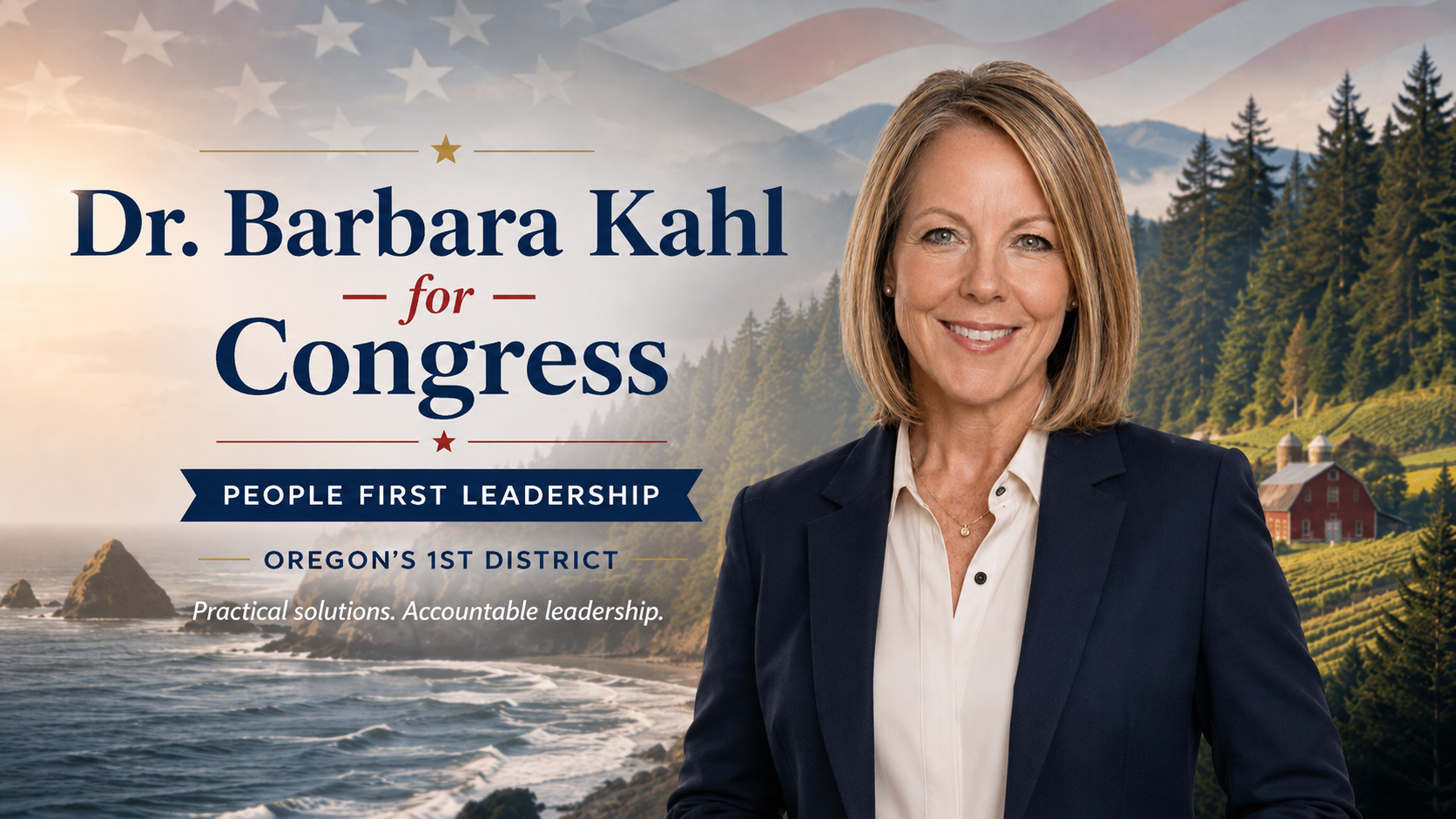
This is an argument against the DSA’s government-first agenda and for Dr. Barbara Kahl’s choice-focused alternative. Suzanne Bonamici cast two “Nay” votes on House resolutions denouncing socialism and supports several policies that move in the same direction. Voters should judge that pattern by control, cost and results.
This analysis of the 2026 election in Oregon’s 1st Congressional District (OR-01) compares Rep. Suzanne Bonamici’s record with challenger Dr. Barbara Kahl’s platform. The core issue is who controls decisions—and whether 14 years of federal policy produced results.
Bonamici did not cause Oregon’s problems by herself. But she has represented Oregon’s 1st District since February 2012. After 14 years, voters can ask what her federal approach accomplished.
OR-01 spans much of Northwest Oregon, from the coast through Washington County and into Multnomah County. Dr. Kahl must explain what she would change and why it would work.
Bonamici’s burden
Defend a 14-year federal record, identify measurable results and explain why another term would improve them.
Dr. Kahl’s burden
Turn principles into specific, lawful, financed proposals with safeguards, deadlines and public measures of success.
Editorial position: This guide by Supportive Oregonians supports Dr. Kahl and opposes the DSA socialism agenda. We believe public ownership, price controls and one-size-fits-all federal programs concentrate power and leave families with fewer options when government gets it wrong. That is a policy judgment—not a claim that Bonamici is a DSA member or accepts every DSA position.
In this article
Oregon’s record: a reason to ask harder questions
These statewide measures do not prove one officeholder caused Oregon’s problems. They do show why voters should demand results from long-serving leaders and specific alternatives from challengers.
Context matters: These are Oregon-wide, not District 1-only, measures. Sources: WalletHub’s 2026 school comparison, HUD’s 2025 Oregon count, CNBC’s 2026 business study and CDC’s Oregon and national overdose data. State and local officials make many direct decisions; Congress sets federal law and spending.
Poor outcomes do not prove that socialism caused them or that Kahl would fix them; they justify scrutiny. Here, “socialism” means greater central control, public ownership or fewer lawful private choices—not every grant, Medicare payment or safety-net program.
H.R. 9824: The Daycare Not Detentions Act and the $70 billion choice
On July 22, 2026, Bonamici introduced H.R. 9824, the Daycare Not Detentions Act of 2026. It proposes $25.5 billion for the Child Care and Development Block Grant, $20 billion for Child Care Entitlement to States, $24 billion for Head Start and $500 million for Preschool Development Grants through fiscal year 2029. A separate section would rescind $70 billion in unobligated Secure America Act funds for ICE and CBP. The bill is not law. Her office says families need affordable care.
H.R. 9824 eligibility and oversight: what the bill does—and does not do
The bill is an appropriations-and-rescission measure. It creates no new eligibility rule, immigration-status check, fraud control, audit, report or outcome requirement. Existing program rules would continue; H.R. 9824 adds none of its own.
For the two Child Care and Development Fund streams, federal rules look at the child’s status—not the parent’s. A child generally must be a citizen or “qualified alien,” but an eligible child cannot be rejected because a parent is undocumented. In Oregon’s ERDC, the state system assigns state rather than federal funding when status is unverified.
Head Start focuses on age, income and categorical need. Courts enjoined a 2025 HHS immigration restriction; HHS says it is not being enforced in Oregon or against Head Start programs nationwide.
The accurate concern: H.R. 9824 does not erase existing safeguards, but it adds no bill-specific verification, fraud control, audit or public-results terms to a $70 billion expansion.
Childcare costs and immigration failures are both real. The bill would not abolish ICE or CBP, but Bonamici should identify which lawful-processing, investigative and enforcement missions could lose money.
Dr. Barbara Kahl’s immigration alternative
In a statement provided to this publication, Dr. Kahl said immigration resources should respect lawful applicants. These are proposals she could advance through legislation, funding, oversight and constituent service. Federal agencies—not one member of Congress—would administer them. Her approach could include:
- Bringing citizenship services closer to communities. Fund recurring USCIS mobile-service days and pilot satellite locations at libraries, community colleges and county buildings. With a signed privacy release, her district office could ask USCIS about delayed cases. Applicants would get official help closer to home; Congress could not approve individual cases.
- Modernizing secure screening. Fund secure digital case files and authorized data sharing, with cyber testing, privacy audits and a way to correct errors. Technology would flag possible matches for trained officers—not make final decisions—reducing repeated paperwork without weakening security checks.
- Reducing lawful backlogs. Tie multiyear funding to hiring trained adjudicators, digitizing paper files, moving suitable digital cases to offices with capacity, and publishing form-by-form goals. These steps reflect GAO’s backlog recommendations. Applicants would receive clearer timelines and faster decisions—not skipped safeguards.
- Supporting English, civics and paperwork mentorship. Expand competitive USCIS citizenship grants for libraries, community colleges and qualified nonprofits to offer classes, practice interviews, online-account help and document organization. Naturalized citizens could mentor newcomers; licensed attorneys or DOJ-accredited representatives would handle legal advice.
- Focusing enforcement on serious criminals, security threats, trafficking and smuggling—with due process. Set funding and reporting priorities for HSI investigations of violent criminal networks, documented threats, traffickers and smugglers, while funding courts and interpreters. Individual evidence, protection screening, hearing and appeal rights, and final lawful orders would protect due process and distinguish victims from traffickers.
Her case is direct: If immigration is broken, use immigration resources to fix it. These ideas would still need bill text, cost estimates, safeguards, measurable goals and public audits.
Why policy overlap matters: No single proposal proves a complete socialism philosophy. Direction becomes clearer when the record is viewed together. Bonamici’s positions would give Washington a larger role in health insurance, childcare funding and labor rules, while H.R. 9824 would move money away from immigration agencies. Dr. Kahl’s approach would keep more decisions with patients, parents, workers, businesses and communities.
This publication is not arguing for no government. It is arguing for government with defined duties and visible results: help people without crowding out lawful alternatives, protect workers without erasing independent work, add housing supply before fixing prices, and use immigration resources to repair the legal system while enforcing the law. That is why the policy differences below matter.

Suzanne Bonamici’s socialism votes: H.Con.Res. 9 and H.Con.Res. 58
In 2023, the House passed H.Con.Res. 9, which denounced socialism “in all its forms,” by 328–86; Bonamici voted “Nay.” See the official House Clerk vote and House-passed text. In 2025, the House passed H.Con.Res. 58, “Denouncing the horrors of socialism,” by 285–98; Bonamici again voted “Nay.” See the 2025 vote and House-passed text.
What the votes prove—and what they do not
The resolutions were nonbinding House measures, not statutes. Their tallies do not prove DSA membership, endorsement or agreement with a full socialist platform. But voters can see Bonamici’s two “Nay” votes. As of Aug. 22, 2026, this article’s review located no explanation from her in either Congressional Record debate or on her official House website. When public actions are not matched by clear explanations, what are voters left to conclude?

What the DSA socialism program proposes—and why we oppose it
The Democratic Socialists of America (DSA) national program goes beyond safety-net spending. It calls for public ownership of the largest corporations and essential industries, universal rent control, social housing, a federal jobs guarantee, publicly owned energy and transit, and ending ICE detention and deportations. It also proposes abolishing the Senate and making the executive and judiciary subordinate to Congress. Its 2025–26 platform supports Medicare for All and free public universal childcare and pre-K.
Why the DSA socialism direction is wrong for Oregon
The DSA points to real problems, but its socialism model repeatedly answers with public ownership, national rules and federal control. We oppose it for five practical reasons:
- It concentrates power. Government ownership leaves fewer alternatives when political management fails.
- Price controls do not create supply. A San Francisco study found rent control helped protected tenants but reduced affected rental supply 15%. One city is not every market, but the risk is real.
- One national model narrows choice. The Congressional Budget Office says single-payer would change coverage, provider payments and financing while leaving private insurance a small role. Universal coverage is worthy; Washington control is not the only path.
- “Free” programs still have tradeoffs. Taxes, federal budgets, provider payments and eligibility rules determine who pays and what remains available.
- Abolition is not reform. Ending ICE detention and deportations would not clear lawful backlogs or stop trafficking and serious crime. Kahl favors faster legal processing, better screening and firm enforcement with due process.
Public spending alone is not socialism. The warning signs are public ownership, lasting central control and fewer lawful choices. Bonamici’s record is not the DSA platform, and overlap does not establish membership. But Medicare for All, federal childcare expansion, stronger federal labor rules and two votes against denouncing socialism form a pattern worth examining. The socialism issue is direction—not guilt by association.

Five issues, one results test
Dr. Kahl starts with a different principle: government should perform core duties, enforce fair rules, publish results and leave room for people to choose. These five issues show why her approach is stronger than the DSA socialism model.
Healthcare
Bonamici belongs to the Medicare for All Caucus and cosponsors the Medicare for All Act of 2025. The DSA also supports Medicare for All. That is socialism policy overlap, not an organizational relationship. Bonamici should explain financing, existing coverage and insurer choice.
Dr. Kahl would protect Medicare without raising seniors’ premiums and hold large healthcare corporations accountable for cost-driving practices. She still must provide bill details and savings estimates, but tackling underlying prices is more appealing than putting one federal plan in control.
Childcare and family choice
Bonamici favors greater federal childcare investment; the DSA favors free public universal childcare and pre-K. Help can improve affordability, but socialism policy must still preserve parents, relatives, private or nonprofit centers, faith-based care, co-ops and local programs.
Dr. Kahl puts families ahead of a federal rulebook. She should publish her aid, cost and quality safeguards, but the $70 billion bill already shows the contrast: every priority has an opportunity cost.
Work and small business
CNBC ranked Oregon 42nd for business in 2026 and 43rd for cost and business friendliness. Congress controls federal taxes and labor law.
Bonamici cosponsors the 2025 PRO Act, which would strengthen unions and apply an ABC test under federal labor law. Kahl’s lower-cost, flexible-work approach is a stronger starting point for small firms and independent workers. She should name the rules she would change and protections against exploitation.
Education: Measure Skills, Not Just Diplomas
Oregon reported a record 83.0% four-year cohort graduation rate for the Class of 2025. That is genuine progress. It is also only one measure. Graduation and academic proficiency are not the same thing, and Oregon’s graduation requirements changed substantially during Suzanne Bonamici’s time in Congress.
The education choice also connects to this article’s broader socialism debate. A systems-first approach points to funding, programs and credentials. A results-first approach asks whether students learned the core skills the system promised to teach.
How socialism fits this education debate: This article is not calling every public school or federal education law socialism. The concern is narrower: socialism becomes relevant when policy protects institutions over families, treats spending as proof of success, limits lawful alternatives or moves decisions farther from parents. The test for socialism-oriented policy should be results, choice and accountability. That distinction keeps the socialism argument focused on policy rather than labels.
On July 14, 2021, Oregon Senate Bill 744 took effect. It temporarily suspended the requirement that students demonstrate proficiency in Essential Skills as a condition of receiving a high school diploma. The diploma skills were reading and comprehending text, writing clearly and accurately, and applying mathematics. The original suspension covered the 2021–22 through 2023–24 school years.
On October 19, 2023, the Oregon State Board of Education extended the suspension through the 2027–28 school year.
Oregon did not eliminate academic standards, required course credits or testing. The state’s official Essential Skills explanation says statewide summative tests, local performance assessments, course credits and personalized-learning requirements remain. What changed was the separate requirement to demonstrate Essential Skills proficiency as a condition of receiving a diploma.
That distinction matters when a rising graduation rate is presented as evidence that education is improving. A higher rate tells us more students are receiving diplomas. By itself, it does not tell us whether students are becoming stronger readers, writers or mathematicians.
This is where criticism of a socialism-style, institution-first approach becomes practical: protecting a system is not the same as proving that the system is producing results for students.
What were students actually scoring during the suspension?
Oregon continued testing students while the Essential Skills graduation requirement was suspended. The state’s 2023–24 assessment files and four-year graduation data provide another way to judge the results. Here is the 2023–24 snapshot for four large districts serving Oregon’s 1st Congressional District:
For the socialism question, these results matter because public investment should be tied to public evidence of learning.
Hillsboro School District
- Grade 3 English language arts
- 37%
- Grade 8 mathematics
- 22%
- Four-year graduation
- 88%
Beaverton School District
- Grade 3 English language arts
- 51%
- Grade 8 mathematics
- 36%
- Four-year graduation
- 88%
Forest Grove School District
- Grade 3 English language arts
- 26%
- Grade 8 mathematics
- 16%
- Four-year graduation
- 83%
Tigard-Tualatin School District
- Grade 3 English language arts
- 45%
- Grade 8 mathematics
- 29%
- Four-year graduation
- 88%
Statewide in 2023–24: 39% of third graders met expectations in English language arts, and 26% of eighth graders met expectations in mathematics.
These figures cover different students at different grade levels. They are not an apples-to-apples comparison. Together, however, they show an important fact: graduation and academic proficiency measure different outcomes.
The goal should not simply be getting more students across the graduation stage. It should be getting more students there prepared for college, skilled trades, military service, employment and adulthood.
A credible critique of socialism asks institutions to earn public confidence through results, not demand confidence because a program exists.
The 83% graduation rate needs context
Oregon’s rising graduation rate is good news. But while the separate Essential Skills graduation requirement was suspended, state testing continued to show substantial numbers of students not meeting grade-level expectations in reading and mathematics.
That does not establish that suspending Essential Skills caused Oregon’s low academic performance. It does establish that an 83% graduation rate cannot, by itself, show that Oregon’s academic performance improved at the same pace.
If Oregon’s leaders celebrate graduation gains, voters should also see what is happening in reading, writing and mathematics.
In the socialism debate, celebrating one favorable number while ignoring weaker measures would be accountability in name only.
The ESSA compromise: give states control, then measure the results
This history matters when considering the Every Student Succeeds Act of 2015, or ESSA.
Bonamici was appointed as one of the House conferees who negotiated the final House-Senate package. ESSA passed with overwhelming bipartisan support—359–64 in the House and 85–12 in the Senate—but that vote represented a compromise between different approaches to federal education policy.
ESSA was not socialism; its bipartisan design is useful here because it separated federal transparency rules from many state and local operating decisions.
Sen. Lamar Alexander of Tennessee, the Republican Senate sponsor and a principal architect of ESSA, wanted to reverse years of growing federal involvement. Alexander and other Republican supporters argued for returning substantial authority to states, school districts, teachers and communities while preserving transparent academic measurements.
Federal law continued to require statewide assessments, disaggregated public report cards and statewide accountability systems. ESSA gave states and districts considerably more discretion to choose standards, design those systems and select evidence-based school-improvement strategies within federal guardrails.
That balance matters in the socialism debate. Transparency and civil-rights guardrails do not require Washington to prescribe every classroom solution.
Alexander described the philosophy this way: “the path to higher standards, better teaching and real accountability will be through states, communities and classrooms and not Washington, D.C.”
The socialism contrast is therefore about where power sits after the public can see the results.
Republican supporters did not argue for ending academic measurement. Their case was that Washington should stop dictating many solutions while still requiring results to remain visible. That created a straightforward accountability test: give states more freedom, measure what happens, publish the results and let families and voters judge.
Oregon has now had years to operate under that framework. The question is no longer hypothetical: What do Oregon’s results show?
Poor results do not prove socialism caused them. They do challenge any government-first argument that treats additional programs or spending as sufficient evidence of success.
Where Suzanne Bonamici’s record matters
Bonamici did not enact Oregon’s Essential Skills suspension, and a member of Congress does not control decisions made in Salem or individual school districts. Her relevance is different: education is one of her signature priorities, and she helped negotiate the federal law that gave states greater flexibility while preserving public reporting.
The argument against socialism here is not guilt by association. It is a demand that long-serving leaders connect policy choices to measurable outcomes.
In the 2011–12 school year, when Bonamici entered Congress, Oregon’s four-year cohort graduation rate was 68.4%. Fourteen years later, the Class of 2025 rate was approximately 83%. That is a major improvement in graduation.
But did Oregon achieve a comparable improvement in reading and mathematics? On the Nation’s Report Card, Oregon’s grade 4 and grade 8 reading and math scores in 2011 were generally closer to the national public-school averages than they were in 2024. COVID-19 caused major learning losses nationwide, so that comparison does not establish that Bonamici, ESSA or one Oregon policy caused the decline. It does make the outcome a fair subject for accountability.
Nothing in these data proves socialism caused Oregon’s academic problems; the figures test whether government-first remedies delivered what their advocates promised.
ESSA gave Oregon flexibility. The results give voters accountability.
One central idea behind the Republican side of the ESSA compromise was that states should have greater freedom to operate their education systems while remaining accountable through transparent measurements.
Oregon received that flexibility. Oregon made its decisions. Now voters can examine the results.
Socialism should not be judged by the size of a program’s budget, but by whether central control improves the outcome.
This does not require blaming Washington for every poor test score or blaming Bonamici for every decision made in Salem. It makes the accountability question simpler: What did Oregon do with the flexibility it was given, and did those decisions produce better academic outcomes?
During the suspension of Oregon’s separate Essential Skills graduation requirement, the graduation rate continued climbing while substantial percentages of students did not meet grade-level expectations in reading and mathematics. Those facts deserve to be considered together.
If graduation improves while proficiency remains weak, policymakers should explain why. If policies are working, the measurements should eventually show that success. If they are not, public reporting gives parents and voters the information needed to demand something different.
Judge education policy by results
COVID-19 must be considered when evaluating Oregon’s recent performance. No single politician, law or policy explains every change in student achievement. But 14 years is long enough to examine a record.
Bonamici has supported federal education legislation, funding and reforms and identifies education as one of her central priorities. Oregon has simultaneously exercised substantial authority over its own education system. Voters can therefore ask: What measurable improvement in student academic achievement followed?
A criticism of socialism becomes credible when it applies the same results standard to every party and every program.
The same standard should apply regardless of party. Spending and programs are inputs. Graduation is an important outcome. Reading, writing and mathematics proficiency help show whether students are mastering core academic skills.
Dr. Kahl’s alternative: results, choice and accountability
Dr. Barbara Kahl’s education approach starts from a different principle: give families greater educational choice while demanding measurable results for students and taxpayers.
That is a direct alternative to a socialism systems-first model: public institutions can remain options, but families should not be trapped when those options do not meet a child’s needs.
Kahl’s break from socialism is meaningful only if her alternatives include enforceable academic standards, transparent costs and protections for every eligible student.
Dr. Kahl supports federal policies that would give families more control over eligible education funds and expand access to public-school alternatives, career and technical programs, approved private-school options, home education, tutoring and qualifying therapy services. The goal is to stop assuming the same system will work equally well for every child.
To turn that principle into legislation, Kahl should specify which federal funds would be eligible, how students with disabilities would be protected, what academic measurements would apply, what the plan would cost and how providers and taxpayer dollars would be audited. Those details matter.
So does the principle behind the proposal: a diploma should represent an education, and education policy should ultimately be judged by what students actually learn.
Oregon should celebrate every student who graduates. But in Hillsboro, Beaverton, Forest Grove, Tigard-Tualatin and communities across Oregon’s 1st District, families deserve to know not only how many students graduate, but whether students are mastering reading, writing and mathematics along the way.
ESSA preserved the measurements needed to answer that question. Congress gave states considerably more control. Oregon exercised that control. Now voters get to judge the results.
After 14 years of Bonamici representing Oregon’s 1st Congressional District, the question should not simply be whether Oregon graduates more students. It should be whether Oregon students are better prepared academically than they were when she entered Congress.
If academic achievement has not improved alongside graduation, then an 83% graduation rate should not end the education debate.
For voters concerned about socialism, education offers a concrete test: judge institutions by the skills students gain, preserve family choices and change course when public results remain weak.
Data note: District percentages are rounded to the nearest whole point from Oregon Department of Education’s 2023–24 assessment and cohort files. The statewide 83.0% rate refers to the 2024–25 Class of 2025.
Housing, ownership and competition
HUD’s 2025 Oregon report counted 27,202 people experiencing homelessness, including 16,500 unsheltered; USAFacts placed Oregon’s rate second-highest. The count is an estimate, but the scale is serious.
The DSA calls for universal rent control and social housing. Kahl’s supply-first alternative—faster permits, financing and construction—is more likely to expand choice than socialism price controls and government ownership. She should name federal actions, costs and safeguards. Judge results by homes built, permit time and fewer people unsheltered.
What Bonamici must explain
Bonamici cannot be blamed for every statewide result, especially where state and local officials control direct decisions. But after 14 years she owns a federal record. Her two socialism votes, Medicare for All support, PRO Act cosponsorship and H.R. 9824 all point toward a larger Washington role. She should show the measurable results of that approach and explain where federal power should end.
What Dr. Kahl must prove
Dr. Kahl offers the clearer alternative. Her platform favors taxpayer oversight, parental authority, patient choice, small-business growth, housing supply and public safety. Her immigration direction combines better lawful service with enforcement and due process.
Her approach asks government to perform essential duties without controlling every decision. Kahl still owes voters bill-level details, costs, safeguards and deadlines. That is a fair standard. But accountability, competition and personal choice are a more promising starting point than expanding federal control after years of weak results.
Five questions voters can use
- Who controls the decision? Congress, a federal agency, Oregon, a local community, a family or an individual?
- What will it cost? Name the funding source and the opportunity cost.
- What measurable result is promised? Spending is an input, not a result.
- When should voters expect that result? A goal without a deadline is difficult to judge.
- What happens if the program fails? Every plan needs audits, public reporting and a way to change course.
These questions neither label every public service socialism nor mistake spending for success. They ask both candidates to protect people in need, preserve lawful choices and show what changed.
Related Oregon reading: Review the DSA’s 2026 socialism agenda, key facts for OR-01 independent voters and Dr. Kahl’s two-term pledge.
The decision after 14 years
Bonamici should be judged on her 14-year federal record. Oregon’s weak results do not prove she caused them, but they make another expansion of federal spending and control difficult to justify without clear evidence it will work.
Dr. Kahl offers the stronger direction: fix core government failures, enforce the law with due process, expand competition and leave more decisions with parents, patients, workers and communities. She must still provide costs, safeguards and deadlines, but her results-first approach is more appealing than the DSA’s government-first model.
Voters need not label Bonamici a DSA member to reject a socialism direction that concentrates federal power. For these reasons, Supportive Oregonians supports Dr. Barbara Kahl for Oregon’s 1st District.
After 14 years, are the results good enough to justify another term?