

News analysis by Supportive Oregonians · Published Aug. 24, 2026 · Records checked Aug. 24, 2026
Before Another $70 Billion: What Oregon’s Childcare Audits Reveal
Oregon childcare audits tell a more complicated story than the claim that insufficient spending alone caused the state’s childcare shortage. Families need dependable care. But before Congress redirects another $70 billion, taxpayers deserve proof that new funding will create staffed, usable openings where parents actually need them.
Oregon’s childcare problem is real. Parents can face long searches, limited hours and prices that strain a household budget. Providers can struggle to recruit workers and keep classrooms open. When reliable care is unavailable, the consequences reach families, employers and communities.
Public records also show why spending cannot be the only measure of progress. A 2025 state investigation identified grants connected to chronic low enrollment, unopened sites and weak financial oversight. Oregon budget documents separately acknowledged publicly funded preschool slots that had been returned and remained vacant. Those findings matter now because Rep. Suzanne Bonamici introduced a nationwide proposal that would provide $70 billion in supplemental childcare and early-learning appropriations while rescinding the same amount in unobligated ICE and CBP funding.
The choice is not between caring about children and ignoring them. It is between competing approaches to government: put substantially more money through existing programs first, or fix the controls, measure the shortage and direct assistance toward results families can see. This analysis reviews five warning signs in the public record and explains the accountability-first alternative Dr. Barbara Kahl should advance.
Editorial disclosure: Supportive Oregonians publishes this independent informational website, supports Dr. Kahl and is not the official campaign. This is a sourced policy analysis, not neutral wire reporting. Readers can inspect the linked government records and judge the argument for themselves.
Warning sign 1: The $1.4 billion estimate is not a spending target
Governor Tina Kotek’s Early Childhood Care and Learning System Roundtable cites a First Five Years Fund projection that childcare challenges cost Oregon’s economy about $1.4 billion each year. The governor’s page attributes that estimate to an outside nonprofit.
The figure deserves attention, but it also needs boundaries. It is an estimated effect on Oregon’s economy. It is not $1.4 billion missing from the state treasury, and it is not a calculation showing that lawmakers must appropriate exactly $1.4 billion more. It identifies a serious symptom without determining the cause or the best treatment.
That distinction is central to a responsible reading of Oregon childcare audits. A shortage can reflect insufficient subsidies, but it can also reflect too few providers, shortages in particular age groups, hours that do not match work schedules, staffing problems, facility costs, licensing delays, geographic gaps or administrative rules that make funded care difficult to use. Those are questions policymakers should investigate; the economic estimate does not settle them.
Some causes may require additional money. Others may require regulatory repair, workforce development, better coordination or a subsidy that follows an eligible family to a qualified provider. A large economic impact proves that inaction has costs. It does not prove that every larger appropriation is well designed.
The $1.4 billion figure tells Oregon that the childcare problem matters. It does not tell Congress how much to spend, which program should receive it or why immigration-enforcement funding should be the source.
Warning sign 2: Oregon already operates a large early-learning system
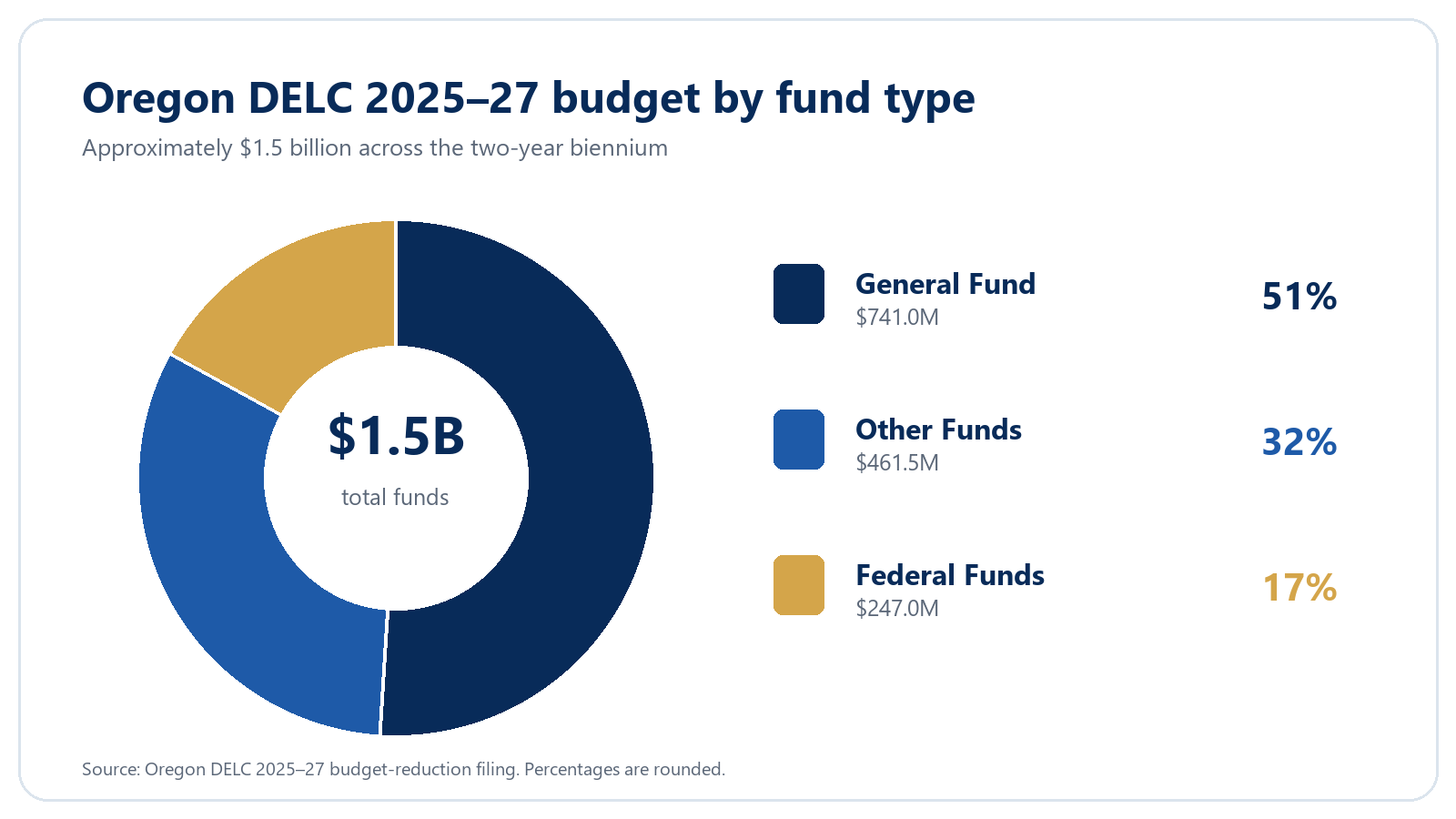
Oregon is not starting from zero. The Legislature’s adopted 2025–27 DELC budget presentation lists total funds of $1,449,541,872 for the two-year biennium. The breakdown is about $740.9 million in General Fund, $461.5 million in Other Funds and $247 million in Federal Funds.
A separate DELC budget-reduction filing says $440.6 million of the Other Funds comes from the Early Learning Account within the Student Success Account, supported by Oregon’s Corporate Activity Tax. The final adopted totals include roughly $1.306 billion for grant-in-aid and $143.3 million for operations—about 90% and 10% when rounded.
Those numbers need context. DELC’s total is not an ordinary daycare budget. The agency funds Employment Related Day Care, Oregon Prenatal to Kindergarten, Preschool Promise, licensing, home visiting, relief nurseries, early-learning hubs and other family supports. Treating every dollar as a daycare subsidy would be inaccurate.
The proper conclusion is narrower and more useful: Oregon taxpayers, businesses and federal taxpayers already support a substantial early-learning structure. The first question before another major federal increase should therefore be, “What results are current dollars producing?”
ERDC shows that public investment has already grown
Employment Related Day Care illustrates the scale. DELC’s agency budget narrative lists $308.7 million approved for 2021–23 and $452.2 million approved for 2023–25. DELC requested $480 million for 2025–27; legislators ultimately adopted about $471.2 million.
The earlier totals included temporary federal COVID and American Rescue Plan money, so the sequence is not a clean measure of permanent growth. Still, it shows that hundreds of millions already move through childcare assistance. The accountability question is not whether government has invested. It is whether investment becomes reliable care at the right age, place and time.
Warning sign 3: Oregon childcare audits found weak controls and missed capacity
In July 2025, the Oregon Secretary of State’s Audits Division released a hotline investigation of Preschool Promise. The plural “audits” matters because the report followed earlier Secretary of State reviews in 2020 and 2024. The 2025 investigation examined fiscal years 2021–24, when Preschool Promise was first administered by the Early Learning Division within the Department of Education and then transferred to the new Department of Early Learning and Care in July 2023.
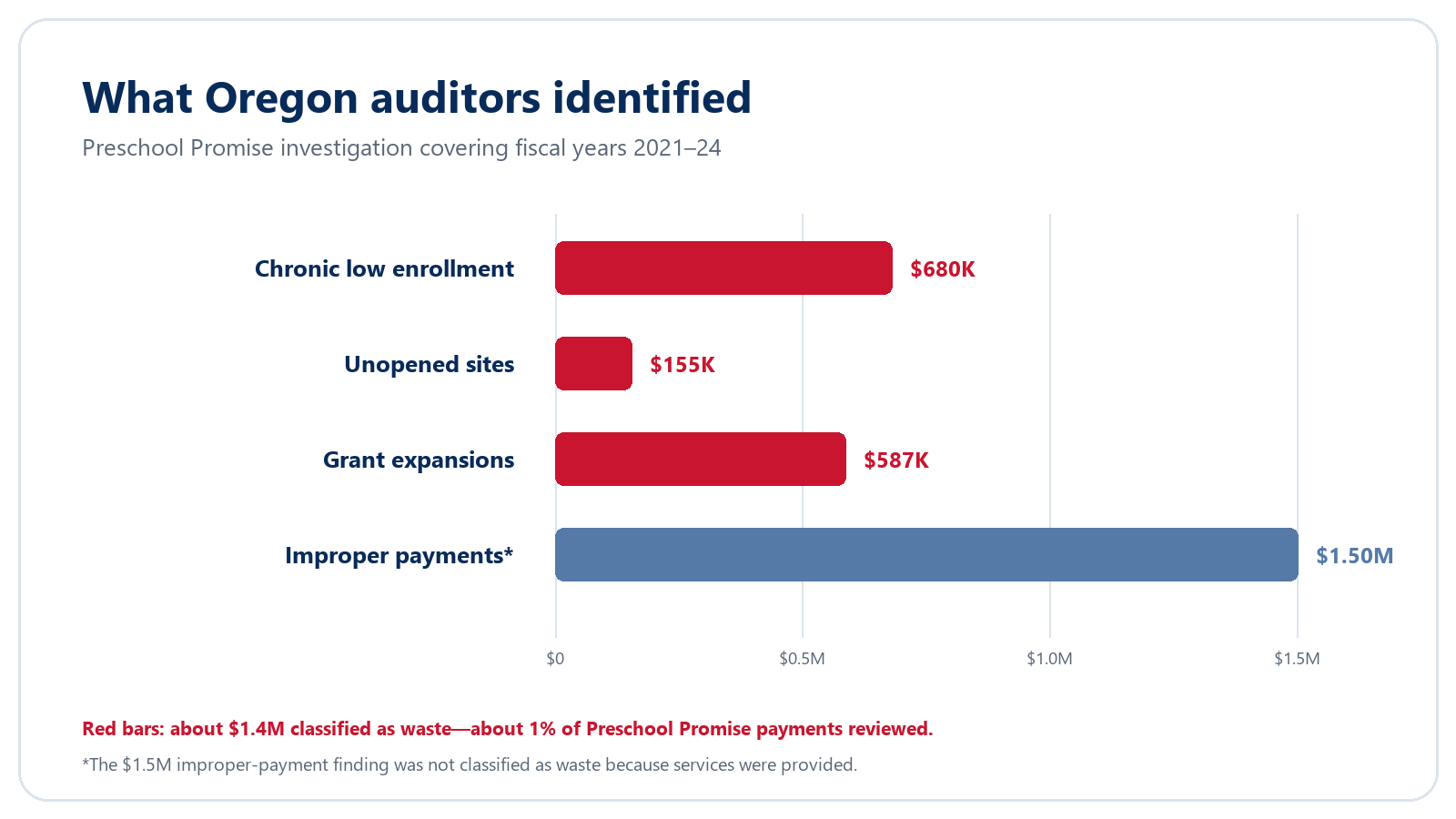
Auditors identified approximately $1.4 million in payments and awards under the predecessor Early Learning Division that they considered wasteful:
- $679,836 tied to chronic low enrollment—not ordinary short-term fluctuations.
- $154,700 tied to three sites during periods when those sites were not open.
- $586,950 tied to three grant expansions during 2022–23 despite weak enrollment evidence.
The report separately identified more than $1.5 million in improper payments to one grantee. Expense reports did not meet the grant agreement’s requirements, and oversight was inadequate. The audit expressly said those payments were not waste because the grantee provided services.
What the investigation did not find: It did not confirm fraud, and it did not say $2.9 million was stolen. The defensible summary is that it questioned more than $2.9 million across two different categories: about $1.4 million classified as waste and more than $1.5 million in improper—but not wasteful—payments.
The $1.4 million classified as waste was about 1% of all Preschool Promise payments during fiscal years 2021–24. That qualifier matters. The finding does not show that every provider failed or that the entire program is wasteful. But 1% is not meaningless when families are waiting for care.
Using an assumed cost of $13,500 per child, auditors estimated the questioned waste could have supported preschool for about 100 additional children over two years. The cited cases served roughly 13 children. Appropriating money and producing usable childcare capacity are not the same result.
The report also credited later improvements
A fair account must include the agency response. Auditors said DELC strengthened controls after the 2023 transfer and made commendable progress during 2024–25. DELC agreed or partially agreed with all 13 recommendations.
That does not erase the underlying warning. Several recommendations involved safeguards taxpayers should expect before a much larger funding stream arrives: stronger monitoring of low-enrollment sites, reliable reporting, reconciliations between payment records, duplicate-payment controls, child-level data, measurable goals and a comprehensive risk assessment.
The Oregon childcare audits therefore support neither extreme. They do not prove that public childcare programs cannot work. They do show that good intentions and appropriations are not substitutes for controls, data and measured results.
Warning sign 4: Vacant funded slots reveal an allocation mismatch
Oregon’s 2025 budget record adds another piece. DELC said a $20 million Preschool Promise reduction mostly involved slots returned during the previous biennium and never reallocated. The filing said those slots were vacant because of enrollment or individual-provider circumstances. It also acknowledged that removing them reduced community capacity while minimizing immediate effects on families.
This is not evidence that Oregon lacks demand for childcare. Preschool Promise primarily serves children ages three to five. A parent seeking infant care cannot use an empty preschool slot. A family in Beaverton cannot use a vacancy hours away. A nurse working overnight cannot use a classroom that closes in the afternoon.
Oregon can have a genuine childcare shortage and vacant publicly funded slots at the same time. The records suggest a mismatch may exist among location, age group, hours, eligibility, transportation, provider readiness and family demand. That is exactly why Oregon childcare spending should be tied to more precise capacity data.
Before expanding an existing model, policymakers should know how many slots are funded, how many are staffed, how many children are actually enrolled, which ages are served, when care is available and where waiting lists remain longest. A statewide budget total cannot answer those questions.
Warning sign 5: H.R. 9824 adds money but no new audit rules
Bonamici introduced H.R. 9824, the Daycare Not Detentions Act of 2026, on July 22, 2026. Her office announced it publicly the next day. The measure was referred to the House Appropriations, Judiciary and Homeland Security committees. It has not become law.
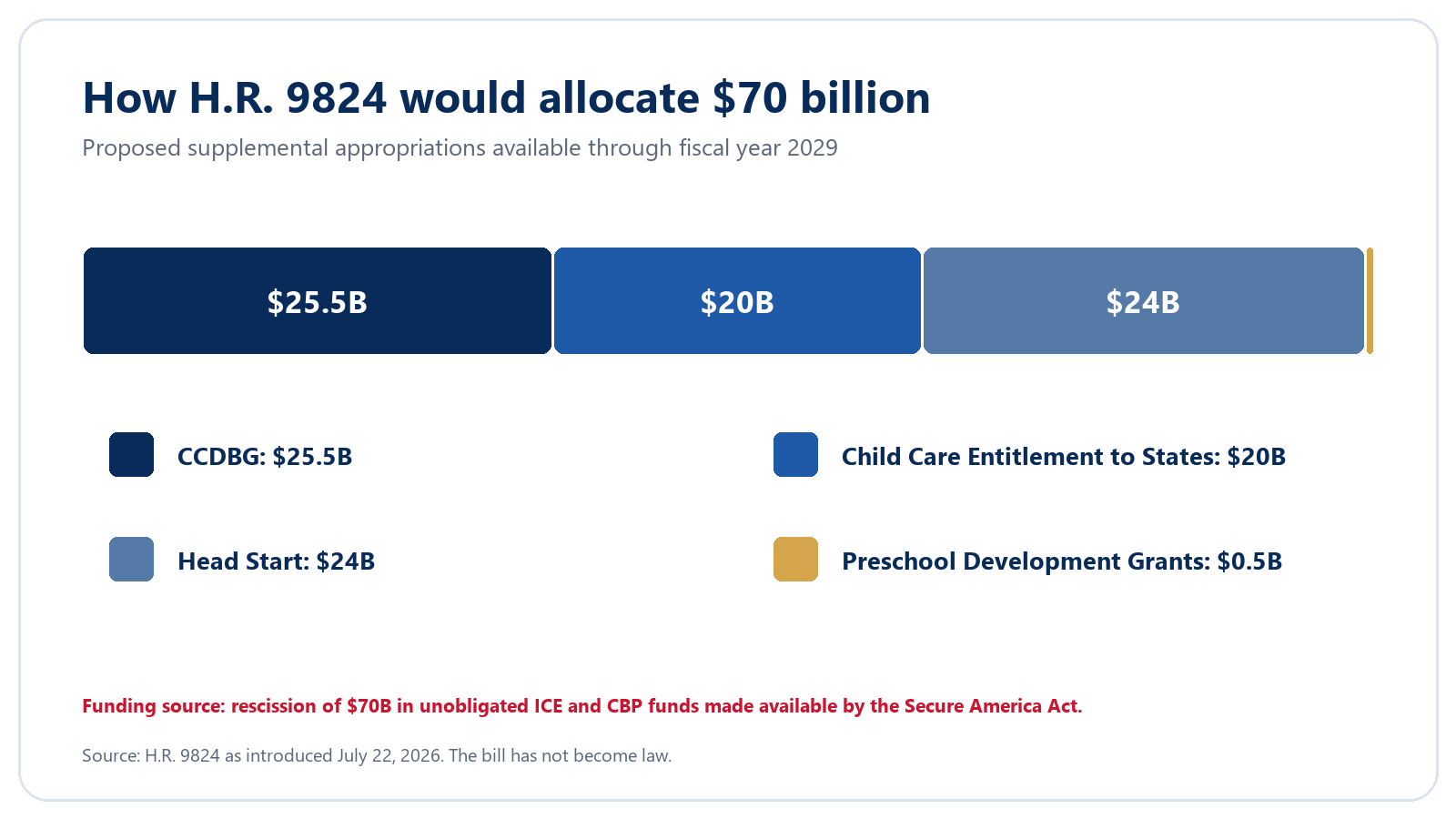
The nationwide bill would create four supplemental appropriations, available through fiscal year 2029:
| Program | Proposed appropriation |
|---|---|
| Child Care and Development Block Grants | $25.5 billion |
| Child Care Entitlement to States | $20 billion |
| Head Start | $24 billion |
| Preschool Development Grants | $500 million |
The accounting mechanism deserves precise language. Section 2 would appropriate $70 billion from the Treasury. Section 3 would offset that amount by rescinding $70 billion in Secure America Act funds for ICE and CBP that remain unobligated on the date of enactment. “Redirect” is a reasonable plain-language summary, but this is not money already spent and then recovered.
The bill is short. It contains four funding lines and one rescission. It does not add new eligibility language, an independent audit mandate, anti-fraud provisions, public scorecards or outcome targets. The money would flow through existing statutory programs under their existing rules.
That does not mean the programs have no safeguards. It means the $70 billion childcare proposal adds no new bill-specific controls despite the scale of the increase. The Oregon childcare audits make that omission important rather than theoretical.
Do not compare $70 billion directly with $1.4 billion
The two headline numbers measure different things. The $1.4 billion figure is an annual Oregon-only economic projection. H.R. 9824 is a nationwide federal proposal whose funds would remain available through fiscal year 2029. It would be misleading to say Bonamici wants to spend $70 billion to solve a $1.4 billion problem.
The accurate criticism is stronger because it is narrower: Oregon’s economic projection does not calculate how much federal spending is required, which existing program would solve the shortage or why unobligated immigration-enforcement funds should finance it.
Voters can support affordable childcare while asking Bonamici to explain which ICE and CBP missions could lose funding, how the new childcare money would increase provider and worker supply, and what measurements would show that families received usable care.
Dr. Kahl’s alternative: Fix both systems instead of trading one for the other
Dr. Barbara Kahl’s stronger approach starts by separating two legitimate problems. Childcare reform should create more safe, affordable and dependable options. Immigration funding should repair lawful processing and enforcement rather than being treated as a convenient account for an unrelated program.
As the site’s earlier analysis of H.R. 9824 explains, changing the use of $70 billion does not itself fix the immigration system. A different bill could preserve core enforcement missions while funding faster lawful processing, secure screening, backlog reduction, court capacity and investigations of serious criminals, trafficking and smuggling—with due process.
For childcare, Kahl should translate her taxpayer-accountability priorities into a results-first federal plan:
- Publish usable capacity data. States receiving major increases should report funded slots, staffed slots, enrollment, waitlists, age groups, operating hours and geographic need. The public should see where the gap actually exists.
- Release expansion money in stages. A new or expanding provider could receive funds as it secures a site, completes safety requirements, hires staff and begins serving children. Rural flexibility should be documented, not improvised.
- Let eligible assistance follow families. Parents should have practical choices among qualified centers, licensed home-based providers, nonprofit programs and community options that meet health and safety standards.
- Grow provider supply. Congress can support apprenticeships, training capacity and targeted startup help in verified shortage areas while reviewing duplicative federal rules. Background checks and child-safety protections should remain firm.
- Condition major increases on audit progress. States should report whether corrective actions are complete, how improper payments are resolved and whether grants produced the promised openings.
- Create public scorecards. Families and taxpayers should see cost per staffed slot, enrollment rates, openings, closures, unresolved findings and administrative expenses.
These ideas would need legislative text, cost estimates and a clear division of federal and state duties. Kahl should provide those details. But the principle is sound: measure the shortage, repair the machinery and direct money toward verified results.
This approach is consistent with the site’s broader positions on federal spending and oversight. It does not ask families to wait indefinitely for reform. It asks government to prove that help reaches them rather than treating an appropriation as the result.
Seven questions Oregon voters should ask before another $70 billion
- What kind of care is actually missing? Infant, toddler, preschool, after-school, evening, weekend or special-needs care may require different solutions.
- Where is the shortage? Statewide totals can hide sharp differences among Washington County, the north coast, west Portland and rural communities in Oregon’s 1st Congressional District.
- How many funded slots are staffed and filled? A promised opening is not usable until a qualified provider can serve a child.
- Which audit recommendations are complete? New money should not outrun the controls designed to protect it.
- What outcome will H.R. 9824 purchase? Congress should identify provider openings, workers recruited, hours expanded and families served—not only dollars distributed.
- Why use immigration funding? Bonamici should explain the opportunity cost of rescinding unobligated ICE and CBP funds and why the two systems should not be reformed independently.
- What happens if results fall short? Every major appropriation needs public reporting, independent review and a way to pause, redirect or recover funds.
The bottom line from Oregon childcare audits
Bonamici is right about the symptom: Oregon families face a serious childcare-access problem. Where her argument becomes debatable is the diagnosis, the funding source and the absence of new performance safeguards in H.R. 9824.
Oregon already operates a roughly $1.45 billion early-learning agency for the current two-year budget. Its own records show meaningful investment, real services and later control improvements. They also show wasteful payments, improperly administered funds, chronic under-enrollment, unopened sites and vacant slots that did not match immediate family use.
The Oregon childcare audits do not prove that more funding can never help. They prove that funding by itself is not a result. A child cannot use a budget line. A parent cannot take an empty slot in the wrong place, for the wrong age or at the wrong hour.
Before Congress adopts H.R. 9824 childcare funding, taxpayers deserve a clear diagnosis, measurable goals, completed safeguards and an explanation for taking money from a separate federal mission. Kahl’s accountability-first alternative is more persuasive because it tries to repair both systems instead of abandoning one problem to finance another.
Primary records reviewed
- Oregon Secretary of State: Preschool Promise hotline investigation
- Full July 2025 audit report and agency response
- Oregon Legislature: adopted DELC budget presentation
- DELC budget overview and reduction filing
- Governor’s Early Childhood Care and Learning System Roundtable
- Authenticated text of H.R. 9824 as introduced