
What Does the DSA Actually Want? Inside the 2026 Agenda to Remake American Government
This is not the Democratic Party platform. It is something more ambitious—and more candid: the Democratic Socialists of America’s own description of the political and economic order it wants to build.
For years, democratic socialism has often been presented to voters as a familiar list of benefits: universal healthcare, stronger unions, higher taxes on the wealthy and a wider safety net. Those ideas are all present in the Democratic Socialists of America’s new national program, Workers Deserve More. But they are only the beginning.
For voters across Oregon’s 1st Congressional District, the debate is not remote. Federal choices about housing, healthcare, public safety, immigration, elections and the balance of constitutional power eventually reach local families, employers and public services from the North Coast to the Portland metropolitan area.
The DSA 2026 agenda reaches past reforming the current system. It calls for a new constitution, a “democratic socialist republic,” public ownership of major corporations and essential industries, and an executive and judiciary answerable to Congress. DSA says some demands can be won under today’s rules, while its complete vision requires a fundamentally different society.
That makes this document worth reading seriously. It is neither a secret conspiracy nor an ordinary progressive wish list. DSA’s national endorsement criteria ask endorsed candidates to uphold the program and the organization’s priorities. The program is not federal legislation, it is not a costed budget, and it is not the Democratic National Committee’s platform. It is a governing vision from an organization working to elect candidates who will advance it.
A fair reading requires two things at once: refusing to caricature DSA’s goals, and refusing to soften their scale. So what would America actually look like if this program became the country’s direction?
Viewed as a whole, the answer is troubling. The program responds to real failures in healthcare, housing, wages and political accountability by moving far more authority into national political institutions, weakening independent checks and leaving basic questions of safety, enforcement, ownership and transition unanswered. Those are not side effects. They are central reasons Americans should reject the DSA agenda while still addressing the grievances that make it attractive.
A New Constitution—and a New Center of Power
The constitutional section is the clearest dividing line between social-democratic reform and systemic reconstruction. DSA proposes abolishing the Senate and Electoral College, expanding the House, adopting proportional representation and ranked-choice voting, replacing the two-party system with a multiparty democracy, and replacing the President and Supreme Court with an executive and judiciary chosen by and “subordinate to Congress.”
Some pieces can be debated independently. A larger House could bring representatives closer to the people. Ranked-choice voting and proportional representation might give voters more choices. Public campaign financing could reduce the influence of wealthy donors.
Taken together, however, the proposals do not merely renovate the American system. They replace its basic architecture. The present Constitution divides federal authority among legislative, executive and judicial branches partly so each can restrain the others. The Library of Congress’s Constitution Annotated describes that independence and friction as a protection against concentrated power.
DSA’s case is that the Senate, Electoral College and current Supreme Court can frustrate majority rule and insulate power from working people. Its answer is to make Congress far more representative and then give that Congress control over the national executive and judiciary.
The objection is not that parliamentary systems cannot be democratic. Many are. It is that DSA offers no detailed transition, no independent institutional safeguard for a congressional minority and no clear explanation of how courts would enforce constitutional limits against the legislature to which they are subordinate. Under the existing amendment process, abolishing equal state representation in the Senate also faces an exceptional barrier: Article V protects each state’s equal Senate suffrage without that state’s consent.
Americans would not simply be choosing different officeholders. They would be deciding whether dispersed authority is an obstacle to democracy or one of democracy’s essential defenses.
Police and Prisons: Reform as a Road to Abolition
DSA’s public-safety plank begins with reforms that have constituencies well beyond the socialist left: demilitarizing police, ending qualified immunity, expanding civilian oversight, weakening police-union protections and treating addiction and mental illness as health issues. It then identifies those reforms as steps toward “fully abolishing the police and prison system.”
That final objective changes the debate. Better crisis response, stronger accountability and alternatives for nonviolent offenders are policy choices within a criminal-justice system. Full abolition requires a substitute for the system itself.
The program does not explain who would respond to murder, armed robbery, kidnapping, sexual assault, organized crime or a violent domestic emergency. It does not say where a person who remains demonstrably dangerous would be confined, who would investigate crimes across jurisdictions, or what lawful power a replacement agency could use when persuasion fails.
DSA’s underlying argument is that poverty, illness and addiction are too often punished instead of treated, and that today’s system applies coercion unequally. That critique deserves attention. But an abolition program must be judged not only by the harms it hopes to end. It must also explain how it will protect the next victim. On that basic responsibility, the national document leaves a consequential blank.
Abolishing ICE—and Removing the Usual Limits on Migration
The immigration section goes well beyond changing enforcement priorities. DSA proposes ending ICE detention and deportations, legalizing migration, granting amnesty regardless of current status, creating a citizenship path for all permanent residents, and ending visa caps and quotas.
Those policies express a coherent moral view: a person’s freedom and dignity should not depend on birthplace, and immigration enforcement has inflicted real hardship on families. They also raise questions the program does not resolve. If deportation ends, migration is legalized and numerical limits disappear, what consequence remains for violating an entry or residency rule? What screening and enforcement authority survives? How should federal, state and local governments plan for changing demand on housing, schools, hospitals and infrastructure?
America can welcome immigrants, protect due process and repair a dysfunctional legal system without pretending all immigration frameworks are the same. The choice DSA presents is not simply compassion versus cruelty. It is whether national membership and border rules should remain enforceable limits at all—and, if they should, who enforces them.
Beyond Regulating Capitalism
DSA does not hide its economic destination. The program opens by imagining daily life after capitalism: no personal debt, no private health insurance, no landlord or mortgage, publicly funded retirement, and food, education, energy, medicine and transportation treated as common goods rather than for-profit businesses.
Its policy section calls for public ownership of the “largest corporations and essential industries,” along with publicly owned energy, transit and social housing. This is not merely a larger welfare state sitting on top of private markets. It would shift control of a substantial share of economic life from private owners and boards to public institutions.
The program does not define how large is large enough, which industries count as essential, whether existing shareholders would be compensated, how managers would be chosen or how investment would be allocated. It does not explain how a publicly controlled company would be allowed to fail, how political favoritism would be prevented, or how consumers could discipline a provider protected from ordinary competition.
Public ownership can take many forms, and the United States already operates public utilities and enterprises. Scale matters. Placing a local water system under public control is not the same as bringing banking, technology, pharmaceuticals, energy, transportation and telecommunications under a national political structure. If the same legislature also chooses the executive and judiciary, political and economic authority would move toward the same center. That concentration is one of the program’s defining risks.
Redefining the Political Community
DSA proposes full voting rights for every permanent U.S. resident, along with voting rights for incarcerated people and people with criminal convictions. The restoration of voting rights after a sentence—and even voting during incarceration—can be debated on the familiar ground of punishment, rehabilitation and civic membership.
Extending federal voting rights to noncitizen permanent residents is a different change. Federal law currently bars noncitizens from voting for federal offices in nearly all circumstances, and USCIS describes voting in federal elections as a right attached to citizenship. DSA would detach that right from citizenship and attach it to permanent residence.
The strongest argument for DSA’s view is straightforward: permanent residents live under American laws, pay taxes and build communities, so they should have a voice in choosing the government that rules them. The opposing principle is equally clear: federal voting is one of the central rights—and responsibilities—that distinguishes citizenship from residence.
This is not a minor election-administration dispute. It asks what citizenship means and whether a nation may reserve political sovereignty to those who have formally joined it.
A Smaller American Footprint in a Dangerous World
DSA’s foreign-policy agenda is built around ending what it sees as American imperial power. It calls for defunding what the document labels the “Department of War,” ending foreign wars, closing overseas military bases, ending all military and economic aid to Israel, supporting international prosecution of alleged war crimes, and ending sanctions and embargoes against governments including Cuba, Venezuela and Iran.
The case for restraint is real. Military interventions can produce unintended consequences, long deployments can become missions without a clear end, and sanctions can burden ordinary people while leaders remain entrenched. A country should never confuse military reach with wisdom.
But withdrawing several pillars of American power at once creates its own risks. Overseas bases are not only launch points for war; they support deterrence, intelligence, logistics, treaty allies, maritime security and rapid disaster response. Sanctions are imperfect, but they are also an instrument between diplomacy and force. Ending them categorically can strengthen governments that repress their own people or threaten their neighbors.
The program offers a moral indictment of the existing order, not a transition strategy for NATO, Taiwan, Israel, international shipping or regional power vacuums. Future generations deserve a foreign policy with fewer reckless wars. They also deserve one that does not mistake retreat for peace.
Housing Rights and the Rent-Control Tradeoff
DSA calls housing a human right and proposes large-scale public social housing, strict regulation of investment properties, tenant counsel and “universal rent control.” The appeal is immediate. A stable home protects family life, employment, schooling and health, while a sudden rent increase can unravel all four.
Rent control can protect people who already have a covered apartment. It can also change what owners build, maintain or keep in the rental market. A widely cited study of San Francisco’s 1994 expansion found that covered tenants were substantially more likely to remain in their homes. It also found that affected landlords reduced rental supply by 15 percent, contributing to higher citywide rents. That is evidence from one policy in one market, not a universal verdict. It does show why design cannot be an afterthought.
DSA’s short program gives no rent formula, construction exemption, maintenance standard, conversion rule or plan for keeping new supply financially viable. Public construction could offset some private pullback, but that requires land, labor, materials, competent management and sustained financing. Declaring housing a right does not make those constraints disappear.
A housing program should be judged by two generations at once: the renter who needs protection today and the family that will need a home ten years from now. Protecting the first while shrinking options for the second is not a durable victory.
Healthcare, Abortion and Gender Policy
DSA proposes universal healthcare at no individual cost, expressly including complete access to reproductive and gender-affirming care. It also calls for ending restrictions on abortion, gender expression and transition, and for making medical education public and free.
Its rationale is bodily autonomy and equal access: medical care should not depend on income, employment, geography or political hostility. That is a serious response to the insecurity many families experience in America’s fragmented healthcare system.
A universal public guarantee also requires public rules. Which procedures are covered? Who defines medical necessity? What standards apply to minors? How are parental rights, state authority and conscience protections for medical professionals handled? How broad is abortion access, and what limits—if any—remain?
The program declares the entitlement but leaves these conflicts unresolved. On issues where medicine, morality, parental authority and religious liberty meet, that omission is not peripheral. It determines whether a promise of universal access can coexist with pluralism.
Reparations and the Meaning of “Finishing Reconstruction”
DSA advocates reparations, treaty and tribal sovereignty, stronger anti-discrimination law, and major investment in jobs, housing and infrastructure in historically neglected minority communities. Supporters understand reparations as compensation for harms that did not end with slavery, because exclusion from property, education, credit and political power continued across generations.
The moral claim does not eliminate the need for rules. Who qualifies? Is eligibility based on ancestry, race, documented injury, economic need or some combination? Who pays? Would a wealthy qualifying descendant receive a benefit while a poor nonqualifying family does not? How should the country treat families that arrived after slavery, or Americans whose ancestors fought against it?
DSA’s program endorses the principle but supplies none of the administrative or distributive framework. A reparations policy meant to heal a historic wound must explain how it will deliver justice without creating a new civic order in which government assigns benefits and burdens primarily by ancestry. Future social trust depends on more than the nobility of the stated purpose.
The Program Is Larger Than Any Single Plank
Each DSA proposal can be isolated and debated on its own. Ranked-choice voting is one argument. Universal healthcare is another. Police accountability, immigration reform, public housing and military restraint each have their own history, evidence and coalitions.
But Workers Deserve More is not a menu of unrelated reforms. It joins constitutional reconstruction, public ownership, police and prison abolition, a transformed immigration system, universal social guarantees, a new understanding of voting, and a reduced American role abroad into one political project.
The diagnosis contains truths that conservatives should not dismiss. Healthcare can be ruinously expensive. Housing scarcity locks young families out. Money distorts politics. Workers can be treated as disposable. A wealthy society should care whether ordinary people can raise children, build a life and retire with dignity.
Yet compassion in the goal does not settle the wisdom of the means. DSA’s answer to concentrated private power is to concentrate far more economic authority in public institutions—while also concentrating federal political authority in Congress. Its answer to unequal enforcement is ultimately to abolish the institutions of enforcement. Its answer to the failures of American power is a sweeping withdrawal whose security consequences are barely addressed.
What the DSA 2026 Agenda Could Mean for Oregon’s 1st Congressional District
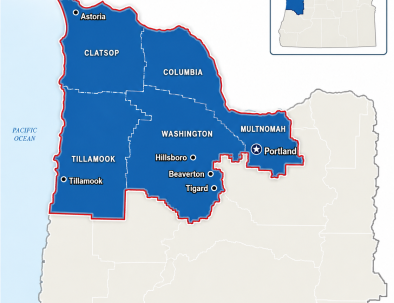
The current district contains all of Clatsop, Columbia and Tillamook counties and portions of Washington and Multnomah counties. It reaches from Astoria, Seaside and Tillamook to St. Helens, Scappoose, Hillsboro, Forest Grove and parts of Beaverton and Portland, as shown on the U.S. Census Bureau’s map for the 119th Congress.
In Hillsboro and Washington County’s technology corridor, voters should ask how public ownership of major corporations and national economic planning would affect investment, innovation, wages and retirement savings. Along the North Coast and Columbia River corridor, the same agenda must be measured against public safety, healthcare access, housing supply, ports, energy reliability and the survival of small businesses. These communities differ, but none would be insulated from national changes to policing, immigration, healthcare, elections or federal authority.
That diversity is why bottom-up leadership matters. Oregon District 1 should not be treated as a proving ground for a national ideological blueprint. Any movement asking for support here should explain, in practical terms, how its proposals protect constitutional rights, strengthen local services, preserve opportunity and improve daily life across the district’s urban, suburban, rural and coastal communities.
The Test Future Generations Will Have to Live With
Political promises are usually sold to the present. Constitutional structures, public obligations and economic incentives are inherited by the future.
The generational test for DSA’s agenda is therefore larger than whether its benefits sound humane. Would its government preserve an independent check when a popular majority is wrong? Would public ownership leave room for experimentation, enterprise and peaceful failure? Would its housing rules produce enough homes for children not yet born? Would its public-safety model protect the vulnerable from both official abuse and private violence? Would its foreign policy keep peace after American deterrence receded?
DSA deserves credit for making its destination visible. It asks Americans to judge democratic socialism not as a label, but as a proposed system. That system promises economic security, wider participation and freedom from private domination. Its chosen means, however, weaken familiar checks on national power, transfer extraordinary authority to public institutions and leave crucial implementation questions unanswered.
Measured against the needs of future generations, the program falls short. A country can guarantee a fairer chance without subordinating courts to Congress. It can reform policing without erasing the institutions that confront violent crime. It can welcome immigrants without making immigration law unenforceable. It can restrain corporate abuses without making politicians the managers of vast sectors of the economy. And it can avoid reckless wars without abandoning deterrence and allies.
The most important question is no longer whether Americans like the word socialism. It is whether they want the political and economic order described in DSA’s own program. The document is clear enough to answer: no. Its diagnosis sometimes lands. Its remedy concentrates too much power, discards too many safeguards and asks future generations to bear risks it has not seriously planned for.
DSA has told the country what it wants. Americans should read it carefully—and choose a better path.
Choose a better path
Common Sense Needs Your Support
Rejecting a sweeping ideological agenda is only half the work. The other half is electing leaders who will protect constitutional checks, strengthen public safety, expand opportunity and return accountability to Washington.
Dr. Barbara Kahl is running to bring practical, people-first leadership to Congress. Eligible supporters across the United States—not only those who live in Oregon—can help her reach voters in Oregon’s 1st District and move common-sense policies forward.
Contributions are processed by the official campaign through WinRed and are subject to federal contribution rules and eligibility limits. This independent informational site does not process donations.
DSA FAQ: Clear Answers for Oregon District 1 Voters
The shorthand surrounding democratic socialism often blurs ordinary public services together with a much broader political program. These answers use DSA’s own Workers Deserve More platform as the baseline and identify where important questions remain.
Question:If you support roads, schools, healthcare and infrastructure, does that mean you support DSA?
No. American governments have funded roads, public schools, hospitals, utilities, emergency services and other common goods for generations under leaders from both parties. Supporting a public service does not require endorsing an entire political ideology.
The defining differences concern ownership, power and constitutional structure. A voter can support a bridge, stronger schools, universal healthcare or resilient infrastructure while rejecting DSA’s proposals for public ownership of the largest corporations and essential industries, full police and prison abolition, its immigration platform or its proposed redesign of the federal government. The honest debate is about how services should be financed and governed, how much government should own or control, and which constitutional limits should remain.
Question:Is DSA’s 2026 program the Democratic Party platform?
No. DSA is a separate socialist organization, and its program criticizes both major parties. It would be inaccurate to attribute every DSA position to every Democrat. DSA should be evaluated by its own published program, and individual candidates should be asked which parts, if any, they support.
Question:Is DSA basically Norway or Sweden with stronger public benefits?
That comparison is incomplete. DSA’s own program describes a future beyond capitalism, public ownership of the largest corporations and essential industries, a new constitution and a democratic socialist republic. That is a broader project than expanding public benefits within the existing American system. The Scandinavian comparison may capture some benefits supporters admire, but it does not describe DSA’s full economic and constitutional destination.
Question:Does democratic socialism simply mean better healthcare and stronger public benefits?
Not according to DSA’s program. Universal healthcare, affordable education and a stronger safety net can all be debated within a mixed-market economy. DSA combines those policies with a wider objective: changing who owns and controls major parts of the economy and replacing central features of the existing constitutional system.
Question:Does DSA just want to tax billionaires and provide stronger benefits?
No. Those proposals are part of its program, but they are not the whole of it. DSA also describes moving beyond capitalism, publicly owning major corporations and essential industries, abolishing the Senate and Electoral College, making the executive and judiciary subordinate to Congress, and drafting a new constitution. The full agenda is structural, not merely redistributive.
Question:Does DSA propose government ownership of every private business?
Its 2026 program does not say that every store, farm or small business would become publicly owned. Claims of total government ownership would go beyond the text. The program does explicitly call for public ownership of the largest corporations and essential industries, but it does not define those categories or explain acquisition, compensation, governance or management.
Question:Is worker ownership or “economic democracy” necessarily a bad idea?
No. Unions, employee ownership, profit-sharing and voluntary cooperatives can all operate within a market economy. DSA’s proposal is broader because it also calls for public ownership of major corporations and industries. The central question is not whether workers deserve a voice. It is whether political or collective institutions should replace private ownership across large portions of the economy, and what safeguards would govern that power.
Question:Would public ownership automatically make major companies more accountable?
Not automatically. Public ownership can serve legitimate public goals, but it still requires people to control budgets, management, prices, investment and losses. A complete proposal needs rules for appointments, audits, conflicts of interest, transparency, consumer choice and failure. DSA states the goal of democratic accountability but does not provide that operating model in its national program.
Question:Does DSA want police and prison reform—or abolition?
Its stated endpoint is abolition. The program describes demilitarization, reduced police-union power, civilian oversight and redirected funding as steps toward fully abolishing the police and prison system. Those reforms can be debated separately, but the ultimate objective should not be softened into ordinary reform. The program does not provide a detailed replacement for responding to violent crime or securely separating demonstrably dangerous offenders from the public.
Question:Does “abolish ICE” simply mean replacing one federal agency with another?
DSA’s proposal goes considerably further than an organizational change. It calls for ending immigration detention and deportations, legalizing migration, granting amnesty regardless of present status, and eliminating visa caps and quotas. The program does not state that every border or citizenship rule would disappear, but it leaves major questions about enforcement, screening, capacity and administration unanswered.
Question:Would DSA’s constitutional proposals simply make government more democratic?
That is DSA’s stated purpose, but the proposed changes are extensive. Its program calls for abolishing the Senate and Electoral College, replacing the two-party system, and making both the executive and judiciary chosen by and subordinate to Congress. Some reforms can be debated individually. Taken together with a new constitution, they would replace rather than merely adjust America’s current system of separated powers and federalism. Voters are justified in asking how minority rights, due process, judicial independence and limits on government would be protected.
Question:What is the fairest way to evaluate DSA’s 2026 agenda?
Read the organization’s own words, distinguish immediate proposals from long-term objectives, and ask how each institution would work in practice. DSA still owes voters important details about public ownership, compensation, business management, public safety after abolition, immigration administration and constitutional protections. Missing detail does not prove the worst possible outcome, but voters can demand clear answers before supporting changes this consequential.
Primary Sources and Further Reading
- Democratic Socialists of America: Workers Deserve More (2026 national program)
- DSA National Electoral Commission: endorsement criteria
- Library of Congress: separation of powers under the Constitution
- Library of Congress: Article V and equal suffrage in the Senate
- U.S. Code, Title 18, Section 611: voting by noncitizens
- USCIS: voting and citizenship after naturalization
- Diamond, McQuade and Qian: evidence from San Francisco rent control
- U.S. Census Bureau: Oregon’s 1st Congressional District map for the 119th Congress
Methodology note: This analysis relies primarily on DSA’s published 2026 program and official electoral rules, with constitutional text and original housing research used for context. The featured photograph of the U.S. Capitol is an Architect of the Capitol work in the public domain.
Related visual context
Source-credited images connected to the article’s policy, geography, or public-accountability themes.